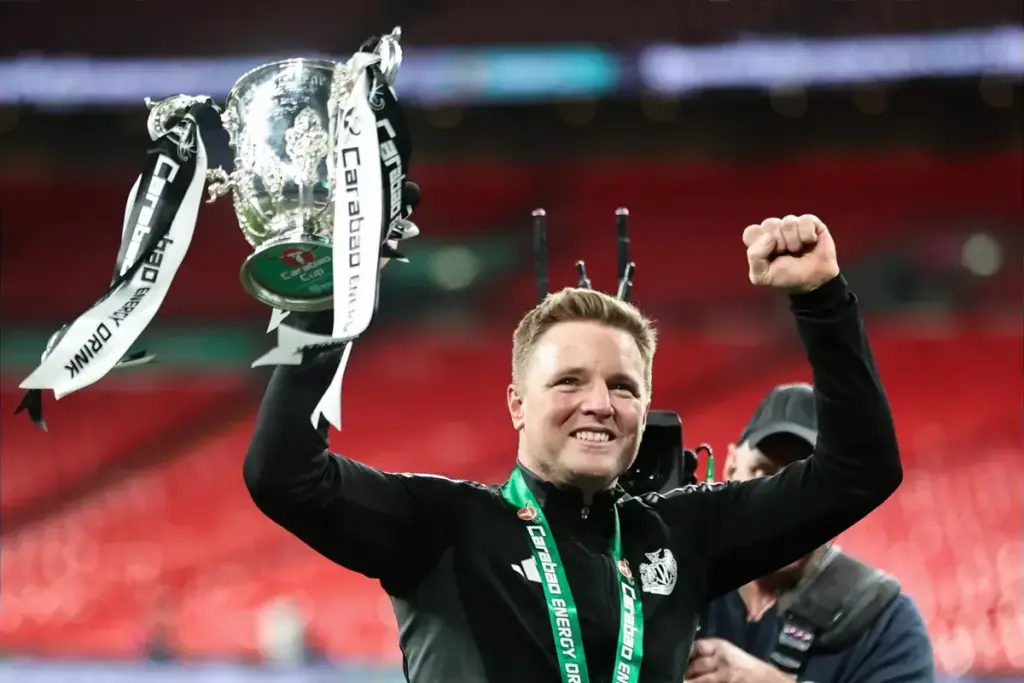

Newcastle United spent last season looking like a club that had forgotten its own blueprint. The relentless, suffocating press that initially defined Eddie Howe’s revolution withered away into a passive, mid-table slog characterised by defensive regression and a lack of squad cohesion.
The departures of Alexander Isak previously, followed by Anthony Gordon’s exit to Barcelona and Sandro Tonali’s £100m move to Tottenham, left a squad starved of identity and bleeding goals. If St James’ Park is to become a fortress again in the upcoming campaign, the Magpies must transition from a team in a state of chaotic transition.
For readers following how elite players are judged across club football and international tournaments, TheLines World Cup
football coverage also shows how quickly narratives can shift when form, fitness and tactical roles change under pressure.
Fixing the Defensive Bleed
The most alarming metric of Newcastle’s recent decline wasn’t the drop in point production, but the complete collapse of their defensive spine. A team that once prided itself on being the most infuriating, compact block in the Premier League began conceding 1.5 goals per game, managing a dismal seven clean sheets across the entire campaign.
The drop-off wasn’t just about personnel; it was tactical. The midfield line regularly failed to track back, leaving an aging and exposed back four to defend massive expanses of open grass. To fix this, Howe cannot rely solely on the eventual return of injured figures or minor tweaks.
The upcoming season demands a tactical reset and a return to the aggressive, coordinated squeezing of opponents that masked individual limitations and turned transition moments into lethal weapons.
Life After the Big Departures
Replacing a player of Anthony Gordon’s tireless work rate and directness is a brutal task, but the summer arrival of 20-year-old winger Bazoumana Touré from Hoffenheim for £43m signals a clear shift in strategy.
Touré brings raw, explosive pace to the left flank, but the burden of replacing Gordon’s output cannot rest entirely on a young player adjusting to the sheer physical demands of English football.
Simultaneously, the massive financial windfall from Tonali’s move to North London has handed sporting director Ross Wilson the leverage needed to overhaul a thin engine room. The impending signature of Ajax wonderkid Sean Steur for £23m is a textbook piece of future-proofing, offering a technical operator who can alternate between the six and eight roles alongside Lewis Miley. Yet, youth alone won’t solve a maturity crisis.
The club’s earlier pursuit of Freiburg’s £51m-rated Swiss midfielder Johan Manzambi indicates that Howe knows exactly what is missing: seasoned, top-tier steel capable of dictating games when the temperature rises.
Guarding the Core and Setting the Target
The final, and perhaps most critical, objective for the remaining weeks of the transfer window is keeping the remaining foundation intact.
Arsenal’s persistent courtship of Bruno Guimarães remains a dark cloud over Tyneside; losing the Brazilian captain on the heels of Tonali’s departure would render any tactical rebuild virtually impossible.
So what is next for Newcastle
Newcastle have to make this the summer where they stop drifting and start choosing a direction. With room created by major outgoing deals, the club should have enough flexibility to act with purpose rather than chase short-term fixes late in the window.
The next season cannot be sold only as another push for Europe. First, Newcastle need to get back to being hard to play against, hard to bully and clear in what they want to be. If Wilson can bring in a commanding centre-back and a proven number nine to give the younger players proper support, the club can stop the slide and start looking upward again.





Comments.
Loading comments…