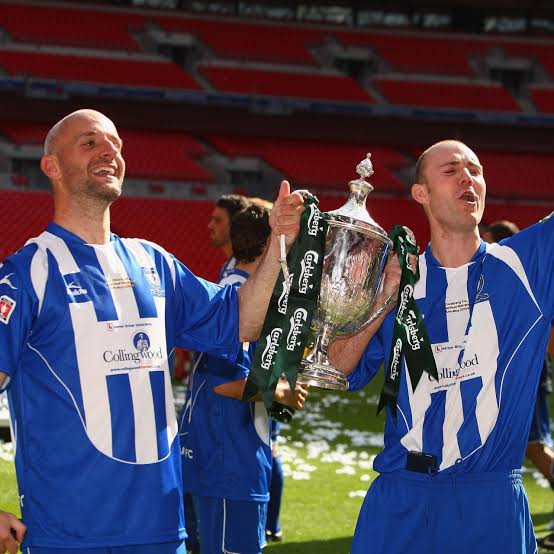

Whitley Bay and the unprecedented Tyneside dynasty that made history
No club has ever matched what Whitley Bay achieved between 2009 and 2011. The ninth-tier Northern League side won three consecutive FA Vase finals, a feat unseen before or since in English non-league football. Add an earlier triumph, and Whitley Bay stands alone as the only club to win the Whitley Bay FA Vase four times.
That run turned a modest Tyneside coastal club into a genuine footballing phenomenon. Crowds swelled, shop windows filled with blue and white stripes, and a town usually defined by its beach and its bars found itself gripped by cup fever every spring.
The story behind that dominance is one of shrewd management, a settled dressing room, and a manager who once scored the very goal that set the dynasty in motion.
How Ian Chandler and Paul McIlduff forged non-league dominance
Ian Chandler’s connection to Whitley Bay’s Vase history began long before he took charge. In 2002, he was a player when he scored the winning goal against Tiptree United in the final at Villa Park. Two years later, he returned as manager and stayed for a decade.
Keeping a title-winning squad together in non-league football is rarely simple. Better-paid clubs often come calling when a player catches the eye. Chandler knew that better than most.
“It’s the hardest thing to keep a team together. As soon as players get noticed, they get picked up at a higher level.”
Whitley Bay reached the Vase semi-finals in 2008 but fell short of the final. Rather than breaking up the squad, that near miss became the spark for what followed.
“But after we got to the Vase semis, players wanted to stay and prove what they could do. Then the lads wanted to do it again.”
Chandler built a team that played with real ambition. He took inspiration from Kevin Keegan’s attacking Newcastle sides of the 1990s. There was even a standing joke within the squad about how attacking they were willing to be.
“There was a standing joke in the team, two or three at the back? One time we chased a game with two at the back.”
His philosophy was simple. He wanted supporters to be entertained.
“The Premier League can be so boring; fans want to be entertained. That’s what we promised.”
Behind the scenes, chairman Paul McIlduff had been shaping the club since 2001. He recruited players who fitted the club’s culture as much as their position.
“We played good football. We had pace on the wing, fantastic midfielders, and strikers who were deadly. The focus went beyond ability. Players also had to fit the dressing room. When we brought them in, it was about fitting the psychology of the dressing room. No-one thought they were better than anyone else, they played for each other.”
Manchester City offer a professional comparison. City won three straight League Cups between 2018 and 2020, then added a fourth in 2021. Whitley Bay achieved something similar nine divisions below the Premier League and on a fraction of the budget.
Statistical proof of Whitley Bay’s record-breaking FA Vase reign
The numbers behind the Whitley Bay FA Vase reign are striking on their own terms. The competition was established in 1974, and in more than fifty years since, only one club has lifted it four times.
Three of those wins came back to back between 2009 and 2011. That run remains unique in the tournament’s history. Whitley Bay had shown their pedigree long before that. They reached the FA Cup third round in 1989-90 after beating Preston North End 2-0 in the second round.
Resilience mattered as much as talent. In the 2007-08 semi-finals, Whitley Bay lost the first leg 4-0 at Lowestoft Town. The tie looked beyond them. They responded with a 3-0 home win. It was a narrow aggregate defeat, but the experience strengthened the squad for what followed.
Two years later, Paul Robinson scored a last-minute diving header against Barwell. The goal completed a 6-5 aggregate win in the 2010 semi-final. It sent Whitley Bay back to Wembley. Robinson came through Newcastle United’s academy and played for Whitley Bay from 2007 to 2013. By then, he remembers his side having a psychological edge over their opponents.
“By the end, teams were turning up afraid of us. We had it won beforehand.”
He recalls one particular quarter-final in 2009 that summed up the gulf between Whitley Bay and much of the non-league landscape they were sweeping through.
“One quarter-final against Biggleswade [in 2009], they turned up in suits and ties. We thought, this is their day out, their cup final. We won 5-2.”
The legacy of Northeast non-league culture and St James’ Park ties
Robinson’s route to Hillheads Park via Newcastle United’s academy adds a distinctly Tyneside thread to the story. He never played for the Magpies’ first team, but his footballing education there shaped the player who became central to Whitley Bay’s Vase runs in a period discussed alongside the club’s own historic Wembley appearances down the years.
Robinson insists it was the earlier rounds that carried the real weight for supporters back home. Those games felt like the biggest occasions in the town’s football calendar long before Wembley came into view. “Everyone goes to the finals, you were there, you could enjoy it,” he said. He also had to balance football with his day job at software firm Sage, where his manager doubled as his football boss. “He was my manager at work and football, I was sick of him,” Robinson joked.
“But it helped get time off for matches.” He admitted that zoning out also happened regularly, with his thoughts turning to scoring, winning and what the opposition might be like. “Hoping they were rubbish so we could have an easy stroll,” he recalled. The wider town embraced the success just as fully. Jenn Robinson, who became a club volunteer, remembers the atmosphere around Whitley Bay in the build-up to those Wembley finals.
“There was such excitement around the whole of Whitley Bay. Every shop had things in the windows, the blue and white stripes.”
Her own involvement with the club came through her late husband’s place on the board. Asked why she got so involved, she explains that she “had to go around there.”
That blend of local pride, careful recruitment and a settled dressing room explains why Whitley Bay’s record stands untouched. Full detail on the club’s run is set out in BBC Sport’s report on Whitley Bay, which carries the recollections of Chandler, McIlduff and the Robinsons in full.








Comments.
Loading comments…