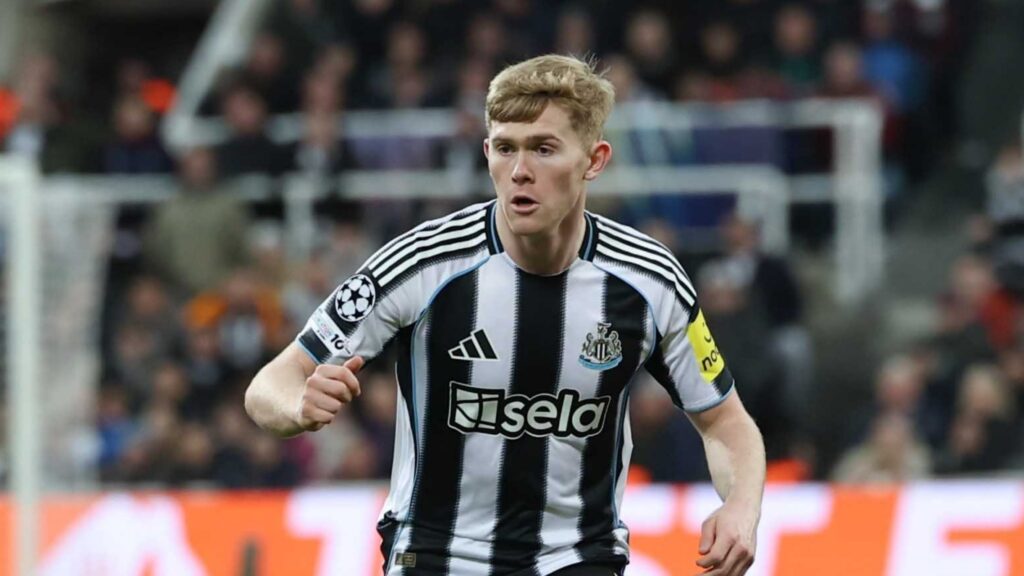

The Premier League has released the full VAR audio from Newcastle United’s 2-2 draw with Liverpool. It offers supporters an unfiltered look at how the stoppage-time penalty against Lewis Hall was reached. The recording, aired on the league’s Mic’d Up programme. It has reopened the debate about where the line sits between a soft call and a justified one.
Late Stoppage-Time Drama at St James’ Park Raises Key Questions
Newcastle had led the way for large spells of an entertaining afternoon at St James’ Park, with Anthony Elanga and Joe Willock both on the scoresheet for Matthias Jaissle’s side. Liverpool responded through Dominik Szoboszlai, who levelled from open play before the game moved into its final act.
Deep into stoppage time, referee Stuart Attwell pointed to the spot after Victor Munoz went down under a challenge from Hall. Szoboszlai stepped up again and converted the resulting penalty, securing a 2-2 draw. This ultimately denied Newcastle a result that had looked within reach. The Liverpool decision instantly became the dominant talking point among supporters, many of whom felt Hall had done little more than compete for the ball.
With the final whistle came the familiar cycle of slow-motion replays and social media debate. It was the release of the officiating audio days later that finally gave fans an insight into how Attwell and his VAR, James Bell, reached their conclusion in real time.
Inside the Released VAR Audio Between Stuart Attwell and James Bell
The audio, detailed in a Chronicle Live report on VAR audio, shows Bell walking through the contact between Hall and Munoz before confirming the on-field decision. Describing the coming together, Bell said: “It’s knee-on-knee contact. He looks to take the ball past him and steps into his leg. He doesn’t play the ball,” as he assessed the incident from multiple angles.
Having reviewed the footage, Bell backed Attwell’s original call without hesitation. “It’s as he said. I’m confirming the penalty,” he told the referee, before adding further detail moments later: “It’s knee-into-thigh contact. We’re confirming the on-field decision of penalty.”
The exchange is notably brief. There is no lengthy deliberation or request for additional replay angles, which points to a VAR team satisfied that the referee’s original read of the incident matched what the pictures showed. Attwell’s decision to award the penalty was never treated as borderline enough to trigger an extended review. The audio confirms that Bell’s role was to verify rather than challenge that judgement.
Howard Webb and Michael Owen Break Down the High Bar for Intervention
PGMOL chief Howard Webb joined presenter Michael Owen on Mic’d Up to unpack why the decision stood. He praised the concentration shown by his officials so late in the contest. “Yeah, I think it’s a really good call late in this game. Former teams of yours, of course, Michael. And it demonstrates some real focus by the officials late in that game. The very last minute of added time,” Webb said.
Webb went on to explain the mechanics of the foul itself, highlighting the importance of Munoz’s possession of the ball in the build-up to contact.
“They’ve worked together well as a team. You’ll hear the assistant referee talk about how Hall hasn’t played the ball. That’s really important because Munoz is in possession of the ball and knocks it past Hall.”
He continued by describing precisely how the challenge unfolded: “Hall doesn’t wipe him out. He puts a foot in. It’s what creates the contact that, in the end, brings Muñoz down.” Webb summarised his overall assessment plainly: “So, a good and important decision right at the end of this game.”
Crucially, Webb acknowledged why some supporters would question the severity of the contact. “I think it’s a penalty. I can see why you’d ask the question because Hall doesn’t wipe him out, does he?” This is where Webb’s explanation moved beyond the specific incident and into the broader principle guiding VAR’s involvement.
“There’s contact when Hall goes in. But we’re using a light touch with VAR. We’re using a high bar for intervention.”
Webb elaborated further, making clear that the outcome could easily have gone the other way had Attwell judged it differently in the moment. “And if the referee says, ‘I’ve seen it. For me it’s contact that’s not impactful enough. We’d probably leave this one alone. Not interfere with this situation, and let the referee’s call stand. And that can happen.” He closed the segment by outlining the threshold VAR is designed to police: “You can prefer a penalty kick as the outcome but not feel it’s quite at the level of being clearly and obviously wrong. That is what VAR is there for. So overall, a good outcome, though.”
What the Mic’d Up Explanation Means for Newcastle’s Season Moving Forward
Webb’s comments do not amount to an admission that Attwell got the call wrong, nor do they suggest VAR overturned anything. Rather, they confirm that Bell’s review simply endorsed a subjective, on-field judgement that fell within the accepted range of interpretation. Had Attwell waved play on, Webb’s own words indicate that outcome would likely have stood too.
For Newcastle, that is a meaningful distinction. It means there is no formal error to point to. No apology to expect. No precedent that changes how future contact inside the box will be treated. Instead, it reinforces that marginal, knee-on-knee or knee-on-thigh challenges sit squarely in referee discretion territory. VAR intervening only when a call is clearly and obviously wrong rather than merely debatable.
That reality will be of little comfort to a squad still searching for consistency after a demanding run of fixtures, including the chastening Leeds United 4-1 Newcastle United match report that exposed defensive frailties of a different kind. Jaissle’s side have shown they can compete with the division’s elite. Liverpool’s performance demonstrated this. Fine margins at both ends of the pitch continue to shape results.
The Mic’d Up release does at least offer clarity rather than controversy. Attwell and Bell followed the process correctly. Webb’s explanation, delivered candidly alongside Owen, shows a system operating as intended even when its conclusions frustrate one set of supporters. Whether Newcastle can turn that clarity into points before the next stoppage-time moment arrives is the question Jaissle’s dressing room now has to answer.



Comments.
Loading comments…