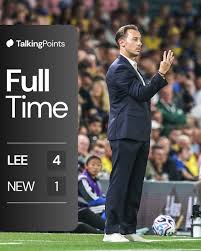

The Cold Reality of Newcastle United’s 4-1 Defeat at Elland Road
Newcastle United arrived at Elland Road on an unbeaten run. They left with the sharpest reality check of Matthias Jaissle’s short time in charge. Beaten 4-1 by a Leeds United side that pressed home every physical advantage on offer.
The result lifted Daniel Farke’s team into third place in the Premier League table and extended an unbeaten start to the season that now reads eight points from four matches. For Newcastle, it means their unbeaten run ended in defeat at Leeds, and it did so in emphatic fashion.
There is no need for panic on Tyneside. Four games into a Premier League season decide nothing on their own. Newcastle have already shown enough this term to suggest Sunday’s defeat was a tactical mismatch rather than evidence of a squad in decline. But nor should the scoreline be waved away as a one-off. Leeds exploited specific, identifiable weaknesses. Physical and structural, that Jaissle will have flagged inside minutes of the final whistle. Those same patterns are likely to resurface against other sides built along similar lines.
How Daniel Farke Built a Physical Powerhouse to Overrun Newcastle
Farke’s rebuild of Leeds since their return to the Premier League has been built on a clear, stated principle. Physical dominance first, everything else second. Of the ten permanent signings made in the summer of 2025, eight stand taller than six feet. This was a recruitment pattern that was no accident of scouting.
Speaking in July 2025, Farke explained the thinking behind it in blunt terms. “I wouldn’t say it’s coincidence that they are all tall players. If you join the Premier League and you have one of the smallest groups, you expect that probably there is more pressure on you than there was in the Championship. You have to make sure that you’re also good in defending crosses.”
The clearest expression of that strategy sits between the posts. Leeds paid Manchester City an initial £40m for goalkeeper James Trafford, a fee that reflected both his shot-stopping and his command of the penalty area. These are qualities that matter enormously in a division saturated with aerial threats. Reports earlier in the year had linked Newcastle’s own goalkeeper with interest from Elland Road. Claims were explored at the time in our Nick Pope Leeds transfer claims coverage, before Leeds ultimately turned to Trafford instead.
At the back, Farke moved quickly to replace Pascal Struijk after his departure to Brighton. He brought in Tarik Muharemovic and Nico Elvedi to shore up the centre of defence. Both fit the same physical template as the rest of the summer rebuild. Dominant in the air, comfortable defending crosses. Willing to impose themselves inside their own box. Newcastle’s forwards found little change out of that pairing at Elland Road, repeatedly drawn into aerial duels they were never built to win.
Height, Form, and Tactical Shifts: The Numbers Behind Leeds’ Rise
The height statistics tell only part of the story. Farke has also shown a tactical flexibility that sits at odds with the idea of Leeds as a purely physical, one-dimensional side. Against Manchester City on 29 November, he switched his team from a back four to a back three at half-time. A change that reshaped their defensive shape. Helping to steady a difficult afternoon. That willingness to adjust mid-match has become a defining feature of his management rather than a one-off tweak born of necessity.
The results since have been striking. Since beating Chelsea at home on 3 December, Leeds have lost only five of their following 29 Premier League matches. A record that places them among the form sides in English football over that stretch. Their unbeaten start this season, eight points from four games, sits comfortably within that trajectory rather than representing an isolated purple patch. Further detail on the scale of Leeds’ physical rebuild, and the numbers behind it, is set out in the BBC Sport report on Leeds United’s recruitment and squad profile.
Up front, Dominic Calvert-Lewin’s revival has supplied the attacking edge to match Farke’s defensive structure. The striker has scored 14 Premier League goals since last December. A run of form that has made him the direct beneficiary of Leeds’ aerial-heavy game plan. Calvert-Lewin has been open about how much he benefits from playing with support rather than as an isolated frontman: “I enjoy having bodies around me.” Against Newcastle, that network of physical runners and crossers gave him precisely the platform his own words describe. The visiting defence had no consistent answer to it.
What Matthias Jaissle Must Correct After Newcastle’s Physical Test
None of this excuses Newcastle’s afternoon. Jaissle will know exactly where his side came up short. Leeds’ dominance in both boxes was the difference between the teams, with crosses and set-piece situations repeatedly punishing a Newcastle back line that was too passive in winning first contact. Against opponents built specifically to win physical duels, half-measures were never going to be enough. The coaching staff will already be working through how to meet that challenge head-on the next time it arises.
Jaissle also needs greater control over the game’s transitional moments. Farke’s structure, whether set up as a back four or the situational back three he has used since the City match, is designed to funnel opponents into areas where Leeds’ size becomes decisive. Newcastle were drawn into exactly that kind of exchange too often on Sunday. They traded physical engagements rather than working the ball through the spaces where their technical quality should have told.
There is a broader lesson here beyond one difficult afternoon at Elland Road. Leeds are far from the only side in the division built around height, physicality and structured pressing. The vulnerabilities exposed on Sunday, a lack of aggression in the air and a tendency to be pulled into direct, physical contests, will not have gone unnoticed by other coaches preparing to face Newcastle. Jaissle has the technical foundation and squad depth to put it right. The question now is how quickly those lessons are applied before the next side with a similar gameplan lines up at St James’ Park or beyond.








Comments.
Loading comments…